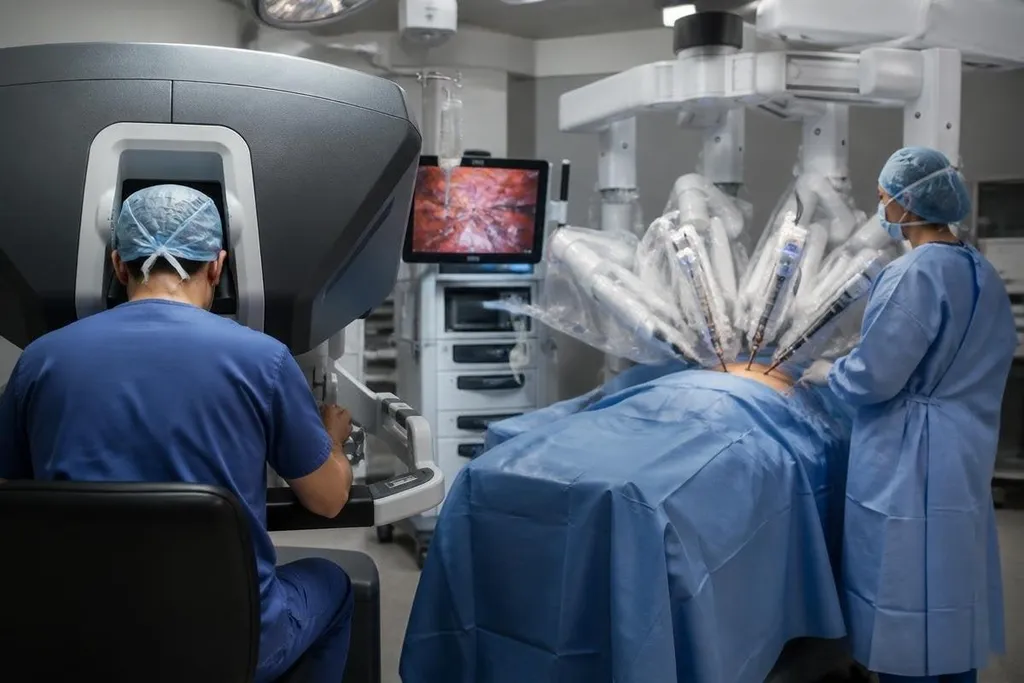
A surgical robot does not operate on a patient by itself. A surgeon controls the instruments from a console, while the system moves small tools inside the body. That setup could improve patient care when it helps the team see, reach, and control tissue with less damage.
- Surgeons control the robot; the system does not make the medical decisions.
- Small, articulated tools can reach areas that are hard to access by hand.
- Better movement in the operating room matters only if it helps patients recover safely.
What the robot adds in the operating room
Most surgical robot systems combine three parts: a surgeon’s console, a camera system, and an operating cart with robotic arms. The camera can give the surgeon a magnified 3D view, while the arms hold instruments that bend and rotate inside the body.
That extra movement can help during tasks that need careful control in a small space. The system can also filter some natural hand tremor and turn larger hand movements into smaller tool movements. These features may help the surgeon place a stitch, separate tissue, or guide a tool around sensitive areas.
The robot does not replace surgical judgment. The surgeon still chooses the procedure, controls the instruments, and responds when the patient’s condition changes. A trained operating team still has to position the patient, manage anesthesia, monitor the patient’s condition, and handle unexpected bleeding.
Where patients may benefit
The possible patient benefit starts with access. A procedure that uses smaller instruments may need smaller cuts than open surgery, though the result depends on the operation and the surgeon’s approach.
Smaller cuts can mean less damage to nearby tissue, less pain after surgery, and fewer days before normal movement returns.
Those benefits are not automatic. A robot can make tool control easier in one operation and add setup time or extra steps in another. The patient’s health, the disease being treated, and the team’s skill still matter more than the label on the equipment.
Robotic surgery may also help surgeons work in places where a straight tool has limited reach. The wristed instruments can change angle inside the body, which may help during pelvic, abdominal, or chest procedures. Each use needs its own evidence; a result from one type of surgery cannot be carried across every operation.
A surgical robot’s clinical claim needs the procedure, patient group, study date, and measured result. Surgical robotics reporting can place those details beside claims about reach and control. Those details lead to the limits hospitals must measure.
The limits hospitals must measure
A robot’s presence does not prove better care. Hospitals need to compare patient results, complication rates, recovery time, repeat operations, and total cost with other methods. They also need to check how often the robot is used, because expensive equipment brings little value when teams cannot schedule enough suitable procedures.
Training adds another limit. A surgeon may understand the operation but still need time to learn the console, camera control, and instrument handling. The wider team needs practice with system setup, tool changes, emergency release, and a switch to standard instruments if the robot stops working.
Access can be uneven too. A hospital with one robot may reserve it for selected procedures, while another may not have the staff or funding to run such a service. That difference can shape who gets the treatment, even when the patient would benefit from another surgical method.
I’d judge a robotic program by patient results and team readiness, not by the number of arms on the operating cart.
A practical check before choosing robotic surgery
If you’re discussing a robotic procedure with a care team, ask:
- Name the operation: Which part of the procedure will the robot handle?
- Compare the options: How does it differ from open or standard minimally invasive surgery for this case?
- Ask about results: What complications, recovery times, and repeat-operation rates does this team record?
- Check the surgeon’s role: Who controls the instruments, and who makes the operating decisions?
- Plan for change: What happens if the system fails or the surgeon needs to switch methods?
The useful measure is the patient’s recovery, not the machine’s appearance. Surgical robots could help when their movement and vision solve a real problem, but hospitals still need patient results to show where that help is worth the cost.